
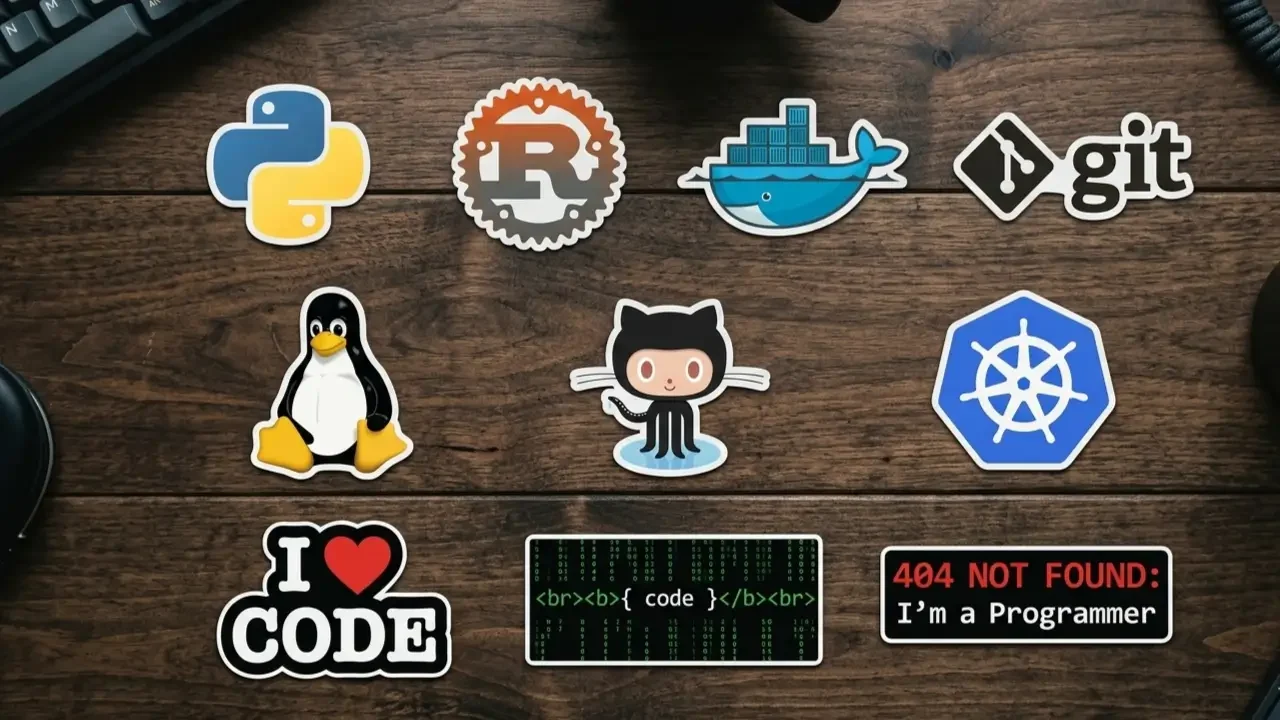
25 Most Popular Developer Laptop Stickers
Every developer community has its own visual language. You can walk into any tech office, open-plan coworking space, or university computer science lab in the world and read the room instantly, not from the whiteboards, not from the commit messages on someone’s screen, but from the laptop lids.
Developer laptop stickers are the most compressed form of professional and cultural identity in tech. A single 2-inch decal communicates your stack, your community affiliations, your sense of humor, and sometimes even your approximate opinions on tabs versus spaces. That’s a lot of signal for something that costs less than a coffee.
But not all stickers are created equal in terms of cultural weight. Some designs have become so embedded in developer culture that they’re practically universal, the visual vocabulary that every developer recognizes regardless of language, role, or company. Others carry specific tribal meaning within particular communities. And some are just genuinely, timelessly funny.
This post covers all 25. We’re going deep on the most popular developer laptop sticker designs in tech culture right now, what they mean, why they resonate, the communities behind them, and where to find quality versions. Think of this as the field guide to developer sticker culture that nobody wrote down before.
For the complete framework on building your sticker collection from scratch, start with the ultimate guide to laptop stickers for programmers. And for the full 50+ idea breakdown by category and aesthetic, our post on laptop sticker ideas for programmers has everything you need for design inspiration.
Let’s get into the 25.
Why Certain Developer Stickers Become Iconic
The Anatomy of a Sticker That Sticks (Culturally)
Before the list, it’s worth asking: what makes a developer sticker go from “design someone made” to “everyone in tech has seen this”? A few consistent factors:
Universal relatability across the dev community. The stickers that achieve iconic status tend to capture experiences every developer has, regardless of specialization. Debugging frustration, caffeine dependency, the localhost joke, these land because they’re true for everyone writing code, not just a specific niche.
A community or project with real cultural gravity. Programming language mascots and open-source project logos achieve icon status because the communities behind them are large, passionate, and sticker-happy. The Python snake isn’t just a logo, it’s a community membership badge worn by millions.
Visual quality that works at small sizes. The best developer stickers translate their meaning clearly even at 1–2 inches. A complicated design that requires reading or close inspection loses its power as a sticker. Clean, bold, instantly readable wins.
The right combination of in-group signal and universal appeal. The best stickers work on two levels simultaneously: they’re funny or meaningful to fellow developers who understand the reference, and they’re visually interesting or inoffensive enough that non-developers can encounter them without friction.
Keep those factors in mind as you read through the list, you’ll see them operating in almost every entry.
The Top 25 Most Popular Developer Laptop Stickers
1. Python – The Snake That Conquered Tech
If there’s a single most universally represented sticker on developer laptops worldwide in 2026, it’s the Python logo. The intertwined blue and yellow snakes are instantly recognizable, beautifully designed, and carry the weight of one of the largest and most diverse programming communities on the planet.
Python’s rise from scripting language to the dominant force in data science, machine learning, AI development, automation, and general-purpose programming has made it ubiquitous. The Python sticker isn’t just a language badge, it’s a declaration that you participate in one of the most vibrant and welcoming communities in all of open-source software.
The Python Software Foundation sells official stickers, and high-quality fan-made versions are available everywhere from Redbubble to TechGeeksApparel’s programmer sticker collection.
Why it’s iconic: Universal community appeal, beautiful design, represents the dominant language of the AI era
2. Tux the Linux Penguin – The Oldest Badge of Honor
Tux is the original developer laptop sticker. Long before sticker culture became the mainstream phenomenon it is today, Linux users were putting Tux on their laptops as a declaration of values: open-source, freedom, self-reliance, and a willingness to spend a weekend configuring your system from scratch.
Tux was designed by Larry Ewing in 1996 and has been the mascot of the Linux kernel ever since. The cheerful, round penguin has spawned hundreds of sticker variants, the classic Tux, Tux in various poses, distro-specific Tux variants, and everything in between.
A Tux sticker means something specific in tech culture. It says: I chose this. I compiled things. I know what a kernel panic is. It carries a quiet confidence that’s been earned.
Why it’s iconic: Historically significant, universally recognized in tech, signals open-source values and technical depth
3. Git – The Backbone of Modern Development
The Git logo, a diamond shape with branching lines suggesting version control history, appears on developer laptops with a frequency that reflects how fundamental Git has become to the entire software development workflow. Every developer uses it. Every team depends on it. It’s as basic as the text editor.
But the Git sticker isn’t just about the tool, it’s a conversation anchor. Put a Git sticker on your laptop and you’ve opened the door to conversations about branching strategies, commit message philosophies, rebasing opinions, and the eternal horror of merge conflicts. Few stickers generate more developer-to-developer discussion than this one.
Why it’s iconic: Universal tooling, conversation catalyst, represents the shared infrastructure of all modern software development
4. Docker – The Whale That Changed Infrastructure
Moby Dock, Docker’s whale carrying a stack of containers, is one of the most beloved mascots in modern infrastructure. Docker fundamentally changed how software is built, shipped, and deployed, and its sticker carries that cultural weight.
A Docker sticker signals: I work in containerized environments. I think about deployment, reproducibility, and infrastructure. I’ve spent quality time with docker-compose files. In the DevOps and cloud-native community, Docker is practically a membership card.
The design, a cheerful blue whale with colorful containers stacked on its back, is charming, immediately recognizable, and scales beautifully to sticker size.
Why it’s iconic: Transformative technology, beloved mascot design, universal in DevOps and cloud-native communities
5. Kubernetes – The Helm Wheel of Cloud-Native Culture
As container orchestration has moved from niche skill to fundamental infrastructure knowledge, Kubernetes has graduated from “that complicated Google thing” to essential technology for anyone working at scale. Its helm wheel logo, clean, geometric, suggesting navigation and control, has become a badge of cloud infrastructure credibility.
A Kubernetes sticker says something specific: I manage complexity. I work at scale. I’ve debugged a pod that wouldn’t start and lived to tell the tale. In DevOps, platform engineering, and cloud-native circles, this sticker carries serious credibility.
Why it’s iconic: Essential infrastructure technology, strong community, signals serious cloud-native engineering experience
6. “It Works on My Machine” – The Universal Developer Excuse
Transitioning from tool logos to humor, this sticker is arguably the single most culturally resonant piece of developer humor ever put on vinyl. The phrase captures something so deeply true about software development, the environment dependency problem, the impossibility of perfect reproducibility, and the developer’s entirely defensible instinct to point out that the code does work, just not necessarily everywhere, that it’s become a universal inside joke.
It works as a sticker because everyone in software development has either said this or had it said to them. It requires zero explanation to any developer. And to non-developers, it reads as slightly mysterious and technical, which adds to its charm.
Quality versions of this classic are exactly the kind of developer humor that TechGeeksApparel’s programmer sticker packs were built for, authentic coding culture humor in durable vinyl format.
Why it’s iconic: Perfectly captures universal developer experience, instantly understood by all developers, works as both self-aware humor and legitimate technical commentary
7. JavaScript – The Most Loved and Most Complained-About Language
The yellow JS square with the black JS lettering is one of the cleanest, most recognizable language badges in existence. And JavaScript’s cultural position, simultaneously the most widely used programming language on Earth and the subject of more developer complaints than almost any other, gives its sticker a fascinating dual energy.
Putting a JavaScript sticker on your laptop is a statement of acceptance. You’ve made peace with type coercion. You understand why typeof null === 'object' and you’ve decided to live with it. You’re probably working with React, Vue, Node, or all three, and you’ve got the npm install horror stories to prove it.
The TypeScript variant, same badge, blue instead of yellow, has been gaining ground rapidly as TypeScript adoption has exploded.
Why it’s iconic: Most-used language on the web, strong community, perfectly encapsulates the love-hate relationship developers have with their tools
8. Rust – The Most Enthusiastic Community in Programming
No community in programming evangelizes their language more enthusiastically than Rust developers, and their sticker game reflects that. The Rust logo (a gear with a crab in various fan art versions, Ferris the crab being the beloved unofficial mascot) appears on developer laptops with increasing frequency as Rust’s adoption in systems programming, WebAssembly, and embedded development grows.
Rust stickers carry a specific signal: I care about memory safety. I’ve fought the borrow checker. I’ve won. The Rust community is known for being welcoming, technically rigorous, and deeply passionate, all of which comes through in the way Rust developers wear their language badge.
Why it’s iconic: Fastest-growing serious language community, beloved mascot, signals systems programming depth and modern technical values
9. “There’s No Place Like 127.0.0.1” – Clever Humor Done Right
The localhost joke is the gold standard of developer humor stickers. It works on multiple levels: it’s a Wizard of Oz reference that anyone can appreciate on the surface, it’s a deeply technical joke (127.0.0.1 is the loopback address, the address that points back to your own machine, “home”) that lands with any developer, and it’s completely inoffensive in any context.
This is the sticker that makes non-technical people smile politely and developers do an actual double-take. That combination of surface accessibility and insider depth is exactly what makes it one of the most enduring pieces of developer sticker culture.
Why it’s iconic: Multi-layered humor, universally understood by developers, appropriate in any professional context, one of the oldest and most beloved dev jokes in existence
10. React – The Component That Conquered Frontend
The React logo, an atom-like symbol with orbital rings, representing the component-based, atomic approach to UI development, has been one of the most common developer laptop stickers since React went mainstream around 2015. It hasn’t slowed down.
React’s dominance in frontend development, its massive ecosystem, and its adoption by companies from tiny startups to the largest enterprises in the world means there are simply a lot of React developers, and a lot of React stickers. The orange-blue orbital design is clean, modern, and unmistakable.
Why it’s iconic: Dominant frontend framework, enormous community, clean and recognizable design
11. Vim – The Exit Joke That Never Gets Old
The Vim sticker comes in two flavors: the clean official Vi/Vim logo, and the humor variant that references the most famous running joke in all of developer culture, that nobody knows how to exit Vim. The ESC :wq sticker, the “I finally exited Vim” badge, and countless variants have all achieved significant cultural traction.
Beyond the humor, the Vim sticker carries genuine cultural weight. Vim proficiency is one of those developer skills that commands quiet respect, it signals comfort with terminal environments, efficiency under constraint, and a certain philosophical commitment to tools that reward investment.
Why it’s iconic: One of tech’s longest-running jokes, genuine cultural credibility, represents a deep divide in developer tool preferences
12. “I Test in Prod” – Dark Humor for the Battle-Hardened
This one occupies a special place in developer sticker culture. “I test in prod” is objectively bad practice, production environments should never be the test environment, and every developer knows it. That’s exactly why it’s funny.
It’s the developer equivalent of a war veteran’s dark humor. You’ve been in the trenches. You’ve shipped things under pressure. You’ve made decisions you’re not proud of and survived the consequences. The sticker wears that experience like a badge.
In tech startup culture especially, this sticker resonates because the “move fast and break things” era produced a generation of developers who have, at some point, absolutely tested something in production and pretended it was intentional.
Why it’s iconic: Perfectly captures the tension between best practices and real-world pressures, dark humor that resonates with experienced developers
13. Linux Distribution Logos – Tribal Badges of the OS Wars
While Tux represents Linux broadly, individual distribution stickers carry their own specific cultural signals:
Arch Linux – “I use Arch, btw” is one of tech’s most famous memes, and the Arch logo sticker carries all of that self-aware, slightly smug energy. Arch users are known for their commitment to a fully customized, manually configured system. The sticker says: I did this the hard way, on purpose.
Ubuntu – The most accessible Linux desktop experience, Ubuntu stickers signal open-source values combined with practical usability. Common on developer laptops across all experience levels.
Debian – The upstream of Ubuntu and many other distros. A Debian sticker signals deep roots in the Debian project and often correlates with server-side and infrastructure expertise.
Pop!_OS – The System76 distro has developed a passionate following among developers who want a Linux experience that just works for development. Its sticker has become increasingly common in 2025–2026.
NixOS – The functional, reproducible Linux distribution beloved by developers who want their system configuration to be as principled as their code. NixOS stickers are niche but carry significant credibility in certain circles.
Why they’re iconic: Tribal community signals, represent specific values and approaches to computing, generate more developer-to-developer conversation than almost any other sticker category
14. “git push -force” – Chaotic Neutral Energy in Sticker Form
Among Git-related humor stickers, git push -force occupies a special place. It’s the command you’re never supposed to run on a shared branch. It rewrites history. It can destroy teammates’ work. And every developer has either done it or been tempted to.
The sticker is a declaration: I understand the risks. I’ve made the calculation. Sometimes history needs rewriting. It carries a specific energy that experienced developers find hilarious and junior developers find slightly terrifying, which is exactly the right reaction.
Why it’s iconic: Captures real developer experience and risk tolerance, instantly understood, perfectly calibrated chaotic neutral humor
15. Coffee-Related Developer Humor – The Caffeine Category
Coffee and programming are so deeply intertwined in developer culture that the entire category deserves a spot on this list. Standout designs include:
while(true) { coffee(); }– The developer’s actual runtime loop- “Caffeine-driven development” – The CDD methodology nobody admits to but everyone practices
- “Coffee.execute()” – Object-oriented coffee dependency
- “Compile. Coffee. Commit. Repeat.” – The daily developer workflow
These stickers work because they’re true. The developer-coffee relationship isn’t a cliché, it’s a lifestyle. And humor that’s grounded in genuine daily experience always lands better than abstract jokes.
Pair your coffee sticker with a funny programmer mug that speaks the same language and you’ve got a fully coordinated caffeine aesthetic for your battlestation.
Why it’s iconic: Grounded in universal daily experience, immediately relatable to every developer, bridges the gap between developer-specific humor and broadly accessible content
16. AWS / Cloud Provider Logos – The Infrastructure Tribe
Amazon Web Services, Google Cloud Platform, and Microsoft Azure stickers have become increasingly common as cloud infrastructure has moved from specialist knowledge to everyday developer reality. AWS in particular, with its orange and black smile logo, is practically universal in backend and DevOps contexts.
These stickers signal: I know where the code actually runs. I’ve configured IAM policies. I’ve been surprised by an AWS bill. The cloud provider sticker is less about humor and more about professional identity, a declaration of where your infrastructure expertise lives.
Why they’re iconic: Represent the dominant deployment environments of modern software, signal real infrastructure experience
17. Stack Overflow – The Unsung Hero of Developer Culture
The Stack Overflow logo sticker deserves more cultural recognition than it gets. Stack Overflow is the actual backbone of how most developers solve problems daily, the resource that’s been open in a browser tab during a significant percentage of all professional code ever written.
A Stack Overflow sticker is honest in a way most professional badges aren’t. It says: I acknowledge where real-world debugging happens. I’ve contributed answers. I’ve asked questions. I’m part of the community that keeps development knowledge alive and searchable.
Why it’s iconic: Honest acknowledgment of how developers actually work, strong community recognition, carries genuine respect in dev culture
18. “Deploy on Friday” – The Horror Sticker
Every developer knows the rule: never deploy to production on a Friday. The odds of something going wrong are the same as any other day, but the consequences of spending your weekend debugging a broken production environment are uniquely devastating.
The “Deploy on Friday” sticker plays on this shared dread. It’s either a warning, a confession, or a dare, depending on who’s reading it. In startup culture especially, where Friday deployments have launched and ended careers, this sticker generates visceral reactions from experienced developers.
Why it’s iconic: Captures universal developer anxiety, perfectly calibrated dark humor, generates immediate reactions from anyone who’s been through it
19. “Hello, World” – The Universal Beginning
“Hello, World” is the first program most developers ever write. It’s the ritual entry point into every new language, every new environment, every new chapter of a developer’s journey. As a sticker, it carries the weight of all of those beginnings simultaneously.
It’s also one of the most accessible developer stickers for non-technical people, it reads as friendly and welcoming, which it genuinely is. “Hello, World” is the moment where someone decided to learn to build things. That’s worth commemorating.
Why it’s iconic: Universal starting point for every developer’s journey, accessible and friendly, carries genuine emotional resonance
20. Ferris the Rust Crab – The Newest Entry to Icon Status
While the official Rust logo is recognized, it’s Ferris, the unofficial Rust mascot, an adorable orange crab, that’s achieved genuine icon status in the Rust community. Ferris was created by Karen Rustad Tölva and adopted enthusiastically by the community, appearing in the official Rust documentation as the “happy crab” and spawning countless sticker variants.
Ferris stickers have grown rapidly in 2024–2026 as Rust adoption has accelerated. Finding a Ferris sticker on someone’s laptop is a reliable way to start a Rust conversation that will last longer than you planned.
Why it’s iconic: Beloved community mascot, reflects the warm and welcoming culture of the Rust community, rising rapidly with Rust adoption
21. “// TODO: Fix This Later” – The Honest Developer
The TODO comment is one of the most honest things a developer can write in code. It says: I know this isn’t right. I don’t have time to fix it now. Future me is going to have to deal with this. And future me always does, eventually.
As a sticker, the TODO joke is immediately relatable to every developer who’s ever left a comment in a codebase that they fully intended to come back to. The humor is in the universal acknowledgment that “later” is a mythical time that never quite arrives.
Why it’s iconic: Perfectly captures the gap between ideal code and real-world deadlines, self-aware humor that every developer identifies with
22. “In Case of Fire: git commit, git push, leave building”
This emergency protocol sticker is a community classic. It’s been around for years and shows no signs of losing its resonance, because the joke is perfect. In the event of an actual emergency, a developer’s first instinct is to save their work before evacuating. The sticker validates that instinct while gently mocking it.
It also works as office decor, plenty of developers frame this one or put it near their desk alongside a fire extinguisher. As a laptop sticker, it’s recognizable to anyone who’s been in a codebase they cared about.
Why it’s iconic: Perfect joke structure, relatable beyond just coding humor, has become part of the canonical developer humor canon
23. “Error 404: Sleep Not Found” – The Developer’s Health Record
The HTTP 404 Not Found error code applied to sleep is one of those jokes that’s funny and slightly sad simultaneously, which is exactly the developer experience. Developers work late. They debug problems that keep them up. They’re in time zones that don’t match their meeting schedules.
The 404 Sleep sticker normalizes the struggle while finding humor in it. It’s also one of the few developer stickers that resonates strongly with non-technical people, the 404 concept has crossed over into mainstream internet culture, making this sticker broadly understood.
Why it’s iconic: Resonates with both technical and non-technical audiences, captures real developer experience, the HTTP code joke format has excellent longevity
24. Neovim / VS Code – The Editor Wars, Stickered
Text editor preferences are one of the defining tribal divisions in developer culture. The Vim versus Emacs war is ancient history, the modern version plays out between Neovim devotees, VS Code maximalists, and everyone who has strong opinions about their plugins.
Editor stickers signal belonging to a tribe and, often, willingness to defend that tribe. VS Code’s clean blue lightning bolt and Neovim’s distinctive green mark both make excellent stickers. Find them on laptops next to each other and you’re guaranteed to witness a spirited discussion about startup time and plugin ecosystems.
Why they’re iconic: Represent one of the most reliably heated debates in developer culture, strong tribal identity signals
25. Your Own Project Logo – The Rarest and Most Personal
The most powerful sticker on any developer’s laptop isn’t one you can buy. It’s the logo of something you built.
Whether it’s a side project, an open-source library you maintain, a startup you co-founded, or a community you help organize, a sticker representing your own work is the most authentic developer identity marker possible. It says: I didn’t just use someone else’s tools. I made something.
If you’ve built something with a logo and a community, get it on vinyl. Sticker Mule and local print shops can produce small custom runs affordably. Put it on your lid and own it.
Why it’s iconic: The most personal and authentic possible developer sticker, represents creation rather than just consumption
Where to Find Quality Versions of These Iconic Stickers
Now that you know what the 25 most popular developer laptop stickers are and why they matter, the obvious next question is where to actually get them in quality vinyl form.
The short answer: for developer-specific humor and curated tech culture stickers, TechGeeksApparel’s programmer sticker packs deliver authentic developer humor in weatherproof vinyl across specialties from web development to data science to network engineering.
For official language and framework logos, check the respective project websites and foundations directly, many sell or distribute official stickers. For the widest variety of designs, Redbubble and Etsy are strong platforms with independent artists covering virtually every language, tool, and joke on this list.
For the full sourcing guide with quality comparisons and price breakdowns, our post on where to get the best laptop stickers for programmers covers every source worth knowing about.
And if questions around professional appropriateness ever cross your mind, particularly when it comes to the humor stickers on this list, our honest breakdown of whether laptop stickers are unprofessional at work gives you the full context.
Building Your Collection Around These Icons
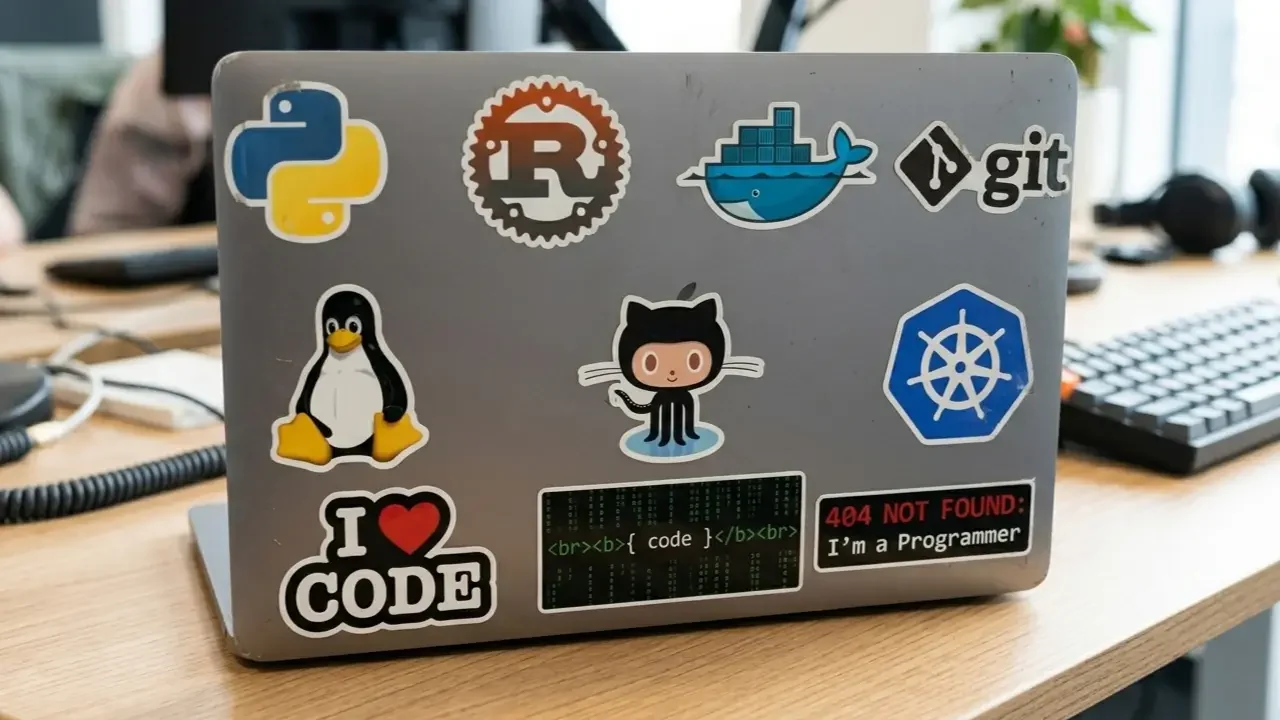
The Starter Kit – Five Stickers That Cover the Basics
If you’re building from zero, these five give you a strong, universally credible developer foundation:
- Your primary programming language logo
- Git (the universal tool badge)
- One open-source project you genuinely use or contribute to
- One funny humor sticker from this list that resonates personally
- Tux or another community badge that reflects where you belong
That’s five stickers. It’s enough to cover meaningful real estate on any laptop lid, communicate a clear developer identity, and start at least two conversations at any tech event.
The Intermediate Setup – Ten to Fifteen Stickers
Once you’ve got the foundation, layer in:
- Secondary language logos for anything you work with regularly
- Framework and tool stickers for your specific stack
- A couple more humor pieces
- Any conference or event stickers you’ve earned
By fifteen stickers with intentional placement, your laptop lid looks curated, not cluttered. This is the sweet spot that most experienced developers land at.
For visual layout planning and placement strategy, revisit our post on laptop sticker ideas for programmers, it covers composition and layout in detail alongside the design ideas.
Complete Your Developer Identity Beyond the Lid
Your sticker collection tells people who you are as a developer the moment they see your laptop. The rest of your setup can speak the same language.
TechGeeksApparel builds gear specifically for developers who want their whole identity to be as considered as their sticker layout. The funny programmer t-shirts carry the same energy as your best humor stickers. The developer hoodies are built for the long sessions where the stickered laptop and the warm hoodie are the only constants. The programmer mugs sit on your desk beside the laptop that started it all. The developer desk mats pull the whole battlestation together.
One aesthetic. One identity. All of it speaking developer.
Conclusion – These Stickers Are Developer Culture Made Visible
The 25 stickers on this list aren’t random designs that happened to become popular. Each one achieved icon status because it captures something true about the experience of building software, the tools, the communities, the humor, the frustrations, and the pride that comes with doing this work.
When you put any of these stickers on your laptop, you’re not just decorating hardware. You’re joining a visual conversation that’s been happening on developer laptops for decades. You’re signaling to other developers: I know what this means. I’ve been there. I’m one of you.
That’s worth a lot more than the few dollars a sticker costs.
Frequently Asked Questions
What is the most popular developer laptop sticker of all time?
It’s genuinely difficult to crown one winner, but “It works on my machine” and the Python logo are consistently the most recognized and widely used developer laptop stickers across all communities and experience levels. Tux the Linux penguin holds the title for historical longevity, he’s been on developer laptops since the late 1990s.
What do developer laptop stickers say about a programmer’s skills?
Stickers are cultural signals more than skill certifications, but they do communicate things. Language and tool logos suggest your stack. Open-source project stickers suggest community involvement. Conference stickers suggest professional engagement beyond your day job. Humor stickers suggest self-awareness and cultural embeddedness. Taken together, a developer’s sticker collection is a surprisingly accurate résumé of their technical identity.
Where can I buy authentic versions of popular developer stickers?
For developer-specific humor and curated packs, TechGeeksApparel’s sticker collection is a top pick. For official language and framework logos, check the respective project websites directly. For the widest variety, Redbubble and Etsy cover virtually every design on this list. Our full guide on where to get laptop stickers covers all sources with quality and price context.
Are these popular developer stickers appropriate for professional settings?
Most of them are, particularly the language logos, tool badges, open-source stickers, and clean humor pieces like “Hello, World” and “127.0.0.1.” The darker humor stickers like “I test in prod” and “Deploy on Friday” are fine in most tech environments but warrant more thought in client-facing or conservative professional contexts. Full guidance is in our post on are laptop stickers unprofessional.
How do I start a developer sticker collection without it looking random?
Start with your primary language and one or two tools you genuinely use daily, that’s your authentic foundation. Add one humor sticker that actually makes you laugh. Place them intentionally rather than randomly. Let the collection grow organically from there as you attend events, join communities, and find designs that genuinely resonate. The best collections look curated because they were, one meaningful sticker at a time.

![A clean flat lay of nerdy gift ideas under $50, featuring a "World's [0] Programmer" t-shirt, a "I Learned Patience the Hard Way" mug, mechanical keyboard keycaps, and tech-themed books](https://techgeeksapparel.com/wp-content/uploads/2026/06/nerdy-gift-ideas-under-50-programmer-essentials.webp)