

Are Laptop Stickers Unprofessional? The Developer’s Honest Guide
Let’s address the elephant in the room, or more accurately, the Python sticker on the laptop in the room.
You’ve got a beautiful collection of developer stickers ready to go. The “It works on my machine” decal. The Rust crab. The perfectly placed git push -force badge that you’ve been saving for the right lid. And then someone, a parent, a recruiter, a well-meaning colleague, looks at your stickered laptop and says the thing: “Isn’t that a bit unprofessional?”
And suddenly you’re second-guessing yourself.
Here’s the real answer: it depends. But not in the vague, non-committal way that phrase usually implies. It depends on specific, identifiable factors, your industry, your company culture, your role, the situation you’re in, and frankly, what’s actually on those stickers. Once you understand those factors, the question stops being anxiety-inducing and becomes something you can navigate confidently.
This post lays out exactly when laptop stickers are completely fine (which is most of the time in tech), when they warrant a second thought, and how to read the room like a senior engineer rather than sweating it out every time you open your laptop in a meeting.
We’ll also tie this back to our complete guide to laptop stickers for programmers for the bigger picture on building a sticker setup you’re actually proud of, professionally and personally.
The Short Answer: In Most of Tech, Laptop Stickers Are Totally Fine
Why Developer Culture Normalized Stickers Long Ago
Software development has never been a buttoned-up profession, and that’s by design. The culture of programming traces its roots through open-source communities, university computer labs, hackathons, and scrappy startups where the dress code was “please wear clothes.” Self-expression, individuality, and personality have always been features of developer culture, not bugs.
Laptop stickers fit directly into that tradition. They signal community membership. They communicate your stack. They show you’ve been places, conferences, hackathons, open-source projects, and done things worth commemorating. In most tech environments, a stickered laptop doesn’t read as “unprofessional.” It reads as experienced.
Think about it this way: when you walk into a team of senior engineers and half of them have stickered laptops, the question isn’t whether stickers are professional. The question is what your stickers say about you.
What the Tech Industry Actually Thinks
The developer community has had this conversation many times, and the consensus that emerges consistently, from discussions on Hacker News, developer surveys, and tech workplace culture research, is that laptop stickers are a non-issue at the vast majority of software companies.
Startups, scale-ups, product companies, open-source organizations, developer tool companies, gaming studios, and most modern tech employers don’t just tolerate stickers, they’re ambient to the culture. Nobody’s pulling engineers aside to discuss their Docker whale decal.
Where the conversation gets more nuanced is at the intersection of tech and more traditional industries, consulting firms, enterprise IT departments serving conservative clients, financial services companies that happen to employ developers, government contractors, and similar environments. We’ll get to those in detail.
Breaking Down the Factors That Actually Matter
Factor 1: Your Industry and Company Culture
This is the most important variable. Company culture varies enormously, and the same stickered laptop can be completely unremarkable in one workplace and mildly eyebrow-raising in another.
Startup and scale-up tech companies: Stickers are essentially the uniform. If anything, a completely blank laptop in a startup engineering team is the unusual one. Nobody’s having HR conversations about your Kubernetes sticker.
Big Tech (FAANG/MAANG-adjacent companies): Also generally fine. These companies hire developers who are deeply embedded in the communities that generate sticker culture in the first place. Internal culture varies by team, but stickers are overwhelmingly normal.
Tech consultancies: Here it starts to get contextual. Internal culture is usually relaxed. But consultancies work with clients, and client-facing situations may call for more neutral presentation. More on this shortly.
Financial services with tech teams: Banks, investment firms, and insurance companies that have software engineering teams often have more formal overall cultures even if the engineering sub-culture is relaxed. Read your specific team’s vibe.
Government and defense contractors: Often formal. Company-issued laptops may have explicit policies. Developer culture still exists within these environments but tends to be more muted.
Healthcare IT: Similar to financial services, the broader organization is formal, but engineering teams often have their own micro-culture. Know your environment.
Factor 2: What’s Actually ON the Stickers
This one gets overlooked in the “are laptop stickers professional” conversation, but it’s genuinely significant. Not all stickers carry the same professional weight.
There’s a spectrum:
Unambiguously fine in any tech context:
- Programming language logos (Python, JavaScript, Rust, Go, etc.)
- Developer tool and framework logos (Git, Docker, Linux, VS Code)
- Open-source project stickers
- Conference and event stickers
- Clean, clever technical humor (“Hello, World”, “127.0.0.1”, etc.)
- Community membership badges
Fine in most tech contexts, worth considering in client-facing situations:
- Mildly edgy developer humor (“I test in prod”, “Deploy on Friday”, “git push -force”)
- Caffeine/sleep deprivation jokes
- Strong opinions about tools (“Vim > Everything Else”)
- Anything mildly political but common in tech (open-source advocacy, privacy rights)
Worth thinking carefully about:
- Stickers with explicit language
- Anything that could be read as hostile or aggressive
- Strongly political content beyond mainstream tech culture values
- Humor that relies on knowledge most people won’t have (can just seem random and strange)
- Anything that might make a colleague or client uncomfortable regardless of intent
The professional question about laptop stickers isn’t really about stickers in general, it’s about content appropriateness for context. A Python logo is universally inoffensive. An explicit-language sticker about a bad Monday is a different calculation.
Factor 3: Your Role and Visibility
Your specific role within an organization affects how much your laptop lid actually matters professionally.
Individual contributor engineers: Lowest professional risk. Your laptop is mostly seen by teammates in a culture that already accepts stickers. The bar is very low.
Tech leads and senior engineers: Still generally fine. Your seniority actually makes stickers more acceptable in many ways, it reads as confidence and established identity rather than trying too hard.
Engineering managers: A slight step up in visibility. You’re in more meetings, potentially with more cross-functional stakeholders. Worth being slightly more thoughtful, though still generally no issue in tech organizations.
Developer advocates and technical evangelists: You’re often representing your company in public, at conferences, on camera. Interestingly, this role often has the most stickered laptops because sticker culture is authentic to the community you’re serving.
CTOs and VPs of Engineering: At this level, visibility is highest and you’re regularly in rooms with executives, board members, and external stakeholders. Context becomes more important. Many senior tech leaders still have stickered laptops, but they’ve usually curated the content thoughtfully.
Factor 4: Whose Laptop It Is
This is a practical point that doesn’t get enough attention.
Your personal laptop: Sticker away. It’s your hardware, your choice, full stop.
Company-issued laptop: Check the policy first. Most tech companies have no issue with it, sticker culture is ambient and IT departments generally don’t care about exterior personalization as long as it doesn’t interfere with the device’s function. But some organizations have explicit policies about modifications to company property, and a vinyl sticker technically counts as a modification.
The fastest way to resolve this: ask someone who’s been at the company a while whether people sticker their work laptops. If half the engineering team already has stickered lids, you have your answer without needing to read an HR policy document.
Specific Situations Where You Should Think Twice
Job Interviews – The Most Common Concern
This is the scenario that makes developers most anxious about their stickered laptops, and honestly, the concern is mostly overblown, but with some real nuance.
At a tech company interview: your stickered laptop is almost certainly a non-issue and may even be a positive signal. It suggests you’re embedded in developer culture, you have opinions about your tools, and you’re the kind of person who goes to the conferences and communities where stickers come from. Most technical interviewers will either not notice, not care, or actually appreciate it.
At a non-tech company that happens to be hiring a developer: more variable. A conservative financial firm hiring its first in-house developer may not have context for sticker culture. A few clean, clearly technical stickers are fine. A chaotic maximalist sticker explosion might read as unusual to interviewers who don’t have dev culture context.
The practical interview rule: Know the company culture before you walk in. If you’re interviewing at a startup or product company, don’t even think about it. If you’re interviewing at a traditional enterprise that’s hiring developers, lean toward a cleaner presentation or use a laptop sleeve for the interview itself.
Client Meetings at Conservative Organizations
If you’re a consultant or developer who regularly meets with external clients, especially in financial services, legal, healthcare, or government, this is where sticker awareness genuinely pays off.
The content of your stickers matters more here than the mere presence of stickers. Technical logos and clean professional stickers are fine even in conservative client contexts. Edgy humor stickers (“I test in prod”) might get a reaction from a client who doesn’t understand the joke, and explaining a sticker during a client meeting is not the impression you want to make.
A practical solution many developers use: a laptop sleeve or skin they can deploy for client-facing situations, letting them keep their sticker setup intact for internal use.
On-Camera Situations – Zoom Calls, Recorded Content, Conferences
When your laptop is visible on camera, it becomes a visible representation of you in a potentially wider context. For most virtual meetings this is a non-issue, your face is the focal point, not your lid. But if you’re a conference speaker, a YouTuber, a streamer, or someone who regularly creates video content, your stickered laptop appears in the background and on screenshares.
For developer-facing audiences, a great sticker setup is a positive aesthetic element. It humanizes you and signals authenticity. For mixed or non-technical audiences, be aware of what’s visible in frame.
What About Company Laptop Sticker Policies?
How to Find Out Without Making It Weird
If you’re at a new company and unsure about the sticker policy on your work laptop, here are three low-stakes ways to find out:
Look around first. Seriously, walk through the engineering area and look at people’s laptops. If 60% of them have stickers, the policy is clearly permissive in practice regardless of what any written document says.
Ask a peer, not HR. A casual “hey, do people put stickers on their work laptops here?” to a colleague you’ve connected with is the most natural way to get an honest answer. HR questions about sticker policies tend to generate very formal responses that may not reflect actual practice.
Check the IT acceptable use policy. If your company has an AUP (most do), it may specifically mention modifications to hardware. Stickers often aren’t covered at all, which generally means they’re fine. If they are mentioned, you’ll have a clear answer.
When the Policy Says No – What to Do
Some organizations genuinely do have policies against stickering company equipment. If yours does:
- Respect it. It’s their hardware.
- Get a personal laptop for your creative expression.
- Use a laptop sleeve with a custom design, technically not a sticker on the laptop itself.
- Express your developer identity through TechGeeksApparel’s programmer t-shirts, developer hoodies, and geek sweatshirts instead. Your wardrobe is always your own.
The “Read the Room” Framework for Laptop Stickers at Work
A Simple Decision Tree for Any Situation
Not sure whether your stickered laptop is appropriate for a specific situation? Run through this:
Is this a tech company or team? If yes → stickers are almost certainly fine. Proceed confidently.
Is this a client-facing situation? If yes → evaluate your sticker content. Technical logos and clean humor are fine. Edgy content warrants more thought. Consider a sleeve for conservative clients.
Is this a job interview? If yes → research the company culture first. Tech companies: proceed normally. Conservative enterprises: lean cleaner.
Is this a company laptop? If yes → check the informal culture (do others have stickers?) and the formal policy (AUP) before applying anything permanent.
Is the content appropriate for the context? Ask yourself: if someone who doesn’t share my cultural reference reads this sticker, what do they see? If the answer is neutral or positive, proceed. If it could be misread as hostile, offensive, or strange out of context, reconsider.
The Surprising Professional Upside of Laptop Stickers
Here’s something the “is it professional” framing tends to miss: in the right context, laptop stickers are actively good for your professional image.
They Signal Community Membership
Stickers from conferences, open-source projects, and developer communities signal that you participate in the broader tech ecosystem beyond just your day job. That’s a positive signal to technical peers and managers who understand the culture.
They Start Conversations That Build Relationships
The number of developer friendships, job opportunities, mentoring relationships, and collaborations that have started with “hey, I use Rust too, what are you building?” while gesturing at a laptop sticker is genuinely impossible to count. Stickers are a social technology.
They Show You Have Opinions
Developers with strong, considered opinions about their tools and their craft tend to be better engineers. A curated sticker layout communicates that you have preferences, you’ve made choices, and you know your stack. That’s not unprofessional, that’s confidence.
How to Build a Professionally Versatile Sticker Setup
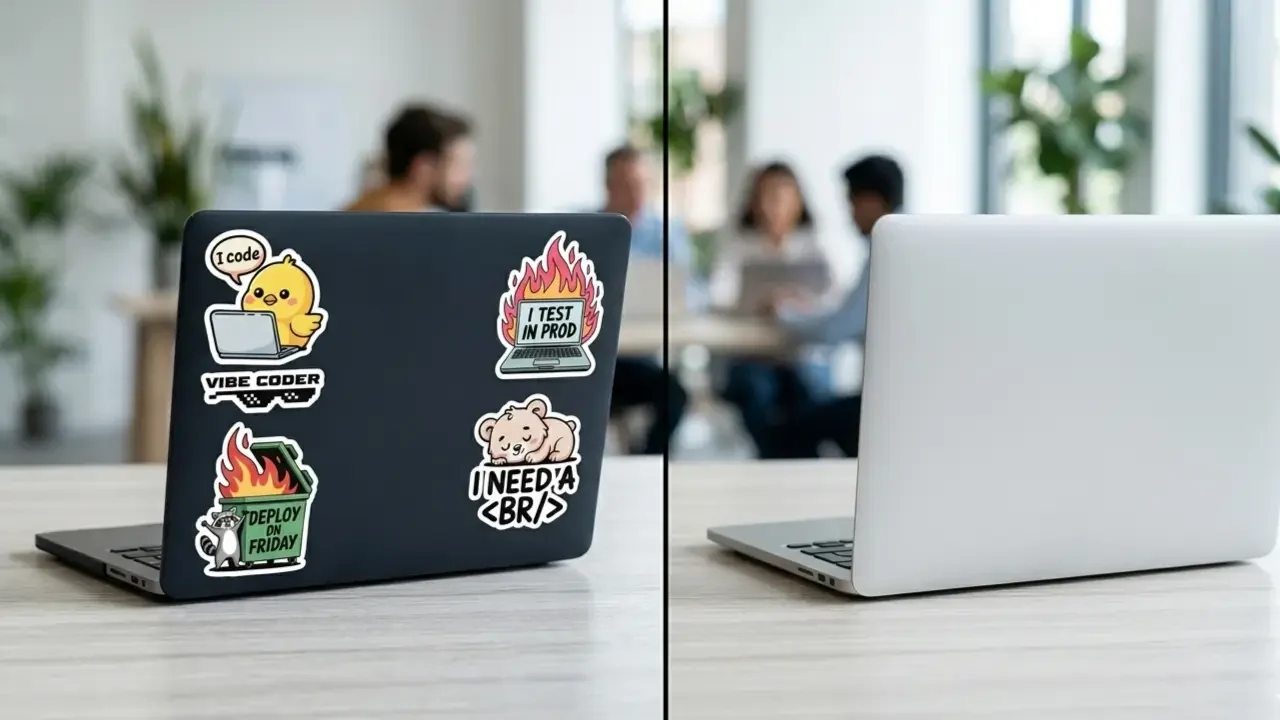
The Layered Approach
Rather than choosing between “no stickers ever” and “maximalist chaos,” consider a layered approach that lets you express yourself while maintaining flexibility:
Layer 1 – The permanent foundation: Your primary language logos, key tool stickers, and community badges. These are clean, universally understood in tech, and appropriate in virtually any professional context involving developers.
Layer 2 – The personality layer: Your favorite humor stickers, opinion badges, and personality pieces. These go on for most of your day-to-day work life. They’re fine at your desk, in team meetings, at conferences, and at tech company interviews.
Layer 3 – The optional sleeve: For those occasions where you want or need a cleaner presentation, high-stakes client meetings, interviews at conservative organizations, formal presentations, a quality laptop sleeve lets you go clean on demand without touching your actual sticker setup.
This three-layer approach gives you maximum expression most of the time and professional flexibility when you actually need it.
For building out that sticker collection thoughtfully, our post on 50+ laptop sticker ideas for programmers gives you a full menu to choose from by category, aesthetic, and intent. And once you know what you want, our guide on where to get the best laptop stickers helps you find quality sources across every price range.
Complete Your Developer Identity Beyond the Lid
If you’re thinking about how your laptop stickers fit into your broader professional and personal identity as a developer, TechGeeksApparel is where the rest of that identity gets built out.
Their programmer sticker packs are purpose-built for developer culture, real inside jokes, quality vinyl, authentic community references. But stickers are just the beginning. A funny developer t-shirt that matches your sticker energy for casual Fridays and tech meetups. A developer hoodie for the long sessions. A programmer mug for the desk. Tech posters for the office wall that guests and Zoom backgrounds will see.
Your professional developer identity is bigger than your laptop lid. Might as well make all of it speak the same language.
Conclusion – Be Intentional, Not Anxious
The honest answer to “are laptop stickers unprofessional?” is this: in most tech environments, for most roles, in most situations, no. They’re not unprofessional. They’re cultural. They’re a legitimate form of professional identity expression in an industry that has always valued authenticity over conformity.
The situations where stickers warrant genuine second thought are real but specific: client-facing roles at conservative organizations, job interviews at non-tech companies, and company laptop policies that explicitly restrict modifications. Outside of those specific contexts, the sticker anxiety is almost always bigger than the actual professional risk.
Know your environment. Know your content. Be intentional about what you put on your lid. And then open your laptop confidently, because a developer who knows their stack, knows their community, and knows how to read a room is never less professional for having a Python sticker.
Frequently Asked Questions
Are laptop stickers unprofessional in a job interview?
At most tech companies, no, a sticker-covered laptop with relevant developer content is a normal and even positive signal in technical interviews. It shows you’re embedded in the community and have opinions about your tools. For interviews at more conservative, non-tech organizations, lean toward cleaner presentation or use a laptop sleeve. The key is researching company culture before you walk in.
Is it okay to put stickers on a work laptop?
It depends on your company’s policy. Most tech companies have no issue with it in practice, check whether your colleagues already have stickered work laptops as the fastest signal. For formal confirmation, check your IT acceptable use policy. If policy is unclear, asking a trusted peer is more useful than asking HR for a policy document.
What kinds of laptop stickers are considered professional?
Programming language logos, developer tool and framework badges, open-source project stickers, conference stickers, and clean technical humor are all considered professional in tech contexts. Explicit language, aggressively edgy content, or anything that could be misread outside of developer culture warrants more careful consideration in mixed or client-facing environments.
Do laptop stickers affect how colleagues and managers perceive you?
In tech culture, thoughtfully curated stickers generally create positive perceptions, they signal community involvement, technical identity, and personality. Random or inappropriate content can create neutral-to-negative impressions. The takeaway: the stickers themselves rarely hurt you, but the content and curation of your stickers communicates something about your judgment.
How do I express developer identity professionally if my company doesn’t allow laptop stickers?
Your wardrobe is always yours. TechGeeksApparel’s programmer t-shirts, developer hoodies, and cozy geek sweatshirts let you express the same developer identity and humor that laptop stickers do, without touching company hardware. A laptop sleeve with a custom design is another option that technically doesn’t modify the device itself.
![A clean flat lay of nerdy gift ideas under $50, featuring a "World's [0] Programmer" t-shirt, a "I Learned Patience the Hard Way" mug, mechanical keyboard keycaps, and tech-themed books](https://techgeeksapparel.com/wp-content/uploads/2026/06/nerdy-gift-ideas-under-50-programmer-essentials.webp)