
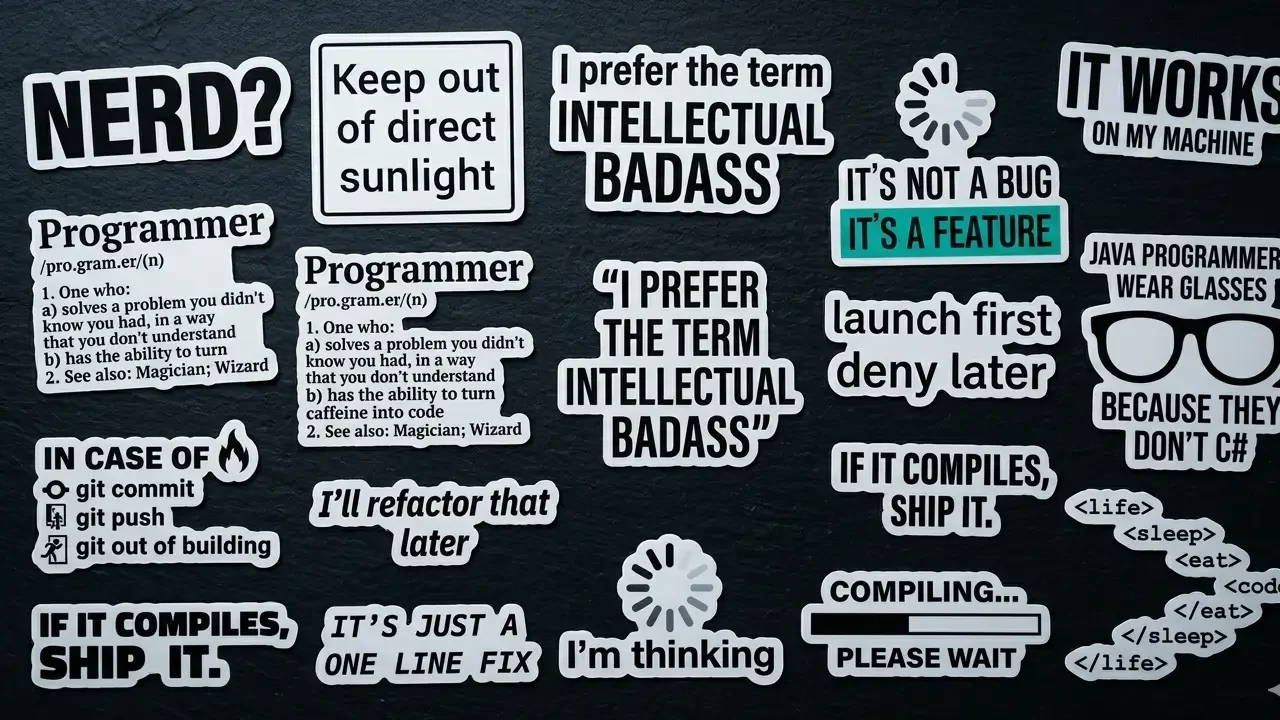
Coolest Laptop Stickers for Programmers
There’s a difference between a stickered laptop and a great stickered laptop.
Both have stickers on them. Both communicate developer identity. But the great one makes people lean in. It has pieces they haven’t seen before. It has stickers with stories behind them, the conference where you got that one, the open-source project you contributed to that sent you those, the indie artist whose work you found before everyone else did. It has designs that make even seasoned developers say: where did you get that?
That’s the tier this post is about.
We’re not covering the basics here, the Python logo, the Docker whale, the “it works on my machine” classic. Those are great and they belong in any developer’s collection. But if you already have those foundations and you’re looking for what elevates a sticker collection from standard to genuinely impressive, you’re in the right place.
This guide covers the coolest laptop stickers for programmers in 2026, rare conference exclusives, limited edition drops, indie artist hidden gems, the most creative designs in developer culture right now, and the strategies that actually work for building a collection that turns heads at every hackathon and tech meetup you’ll ever attend.
For the full foundation, safety, sourcing, layout planning, and the complete design universe, the ultimate guide to laptop stickers for programmers has everything. This post goes after a specific and particularly exciting slice of that world.
Let’s get into what makes a laptop sticker genuinely cool.
What Separates a Cool Sticker From a Common One
The Rarity Dimension
In any collectible culture, and developer sticker culture absolutely qualifies, rarity creates value. Not monetary value necessarily, but social and cultural value. A sticker that every developer has seen before communicates participation in the community. A sticker nobody else seems to have communicates depth of participation, the sense that you’ve been places, done things, and accumulated artifacts that others haven’t had access to.
Rarity in sticker culture comes from several sources:
Geographic exclusivity – Stickers distributed at a specific regional conference, local meetup, or city-specific developer event that most people couldn’t attend.
Temporal exclusivity – Limited edition drops that were available for a specific window and are now gone. Conference stickers from events that have since ended. First-edition designs that have been updated or discontinued.
Community depth exclusivity – Stickers you get from contributing to an open-source project, reaching a milestone in a developer program, or being part of a community that doesn’t publicize its swag externally.
Indie creator exclusivity – Designs from artists with small followings who haven’t yet been discovered by the broader market. The sticker equivalent of hearing a band before they got big.
Understanding where rarity comes from helps you build a strategy for finding and acquiring rare stickers rather than just hoping you stumble across them.
The Design Quality Dimension
Beyond rarity, genuinely cool stickers tend to have design quality that stands apart from the average. This means:
Exceptional concept execution – The joke or idea behind the sticker is clever in a way that’s not immediately obvious. It rewards closer inspection. It works on multiple levels simultaneously.
Distinctive visual style – Something about the artwork feels intentional and unique rather than generic. Holographic finishes, unusual die-cut shapes, hand-drawn aesthetics, or deliberately minimal design choices that most sticker manufacturers wouldn’t attempt.
Technical accuracy – Designs that get the details right in ways that resonate with developers who notice. The correct syntax in a code snippet. The accurate representation of a protocol. The real algorithm in the visualization.
Authentic cultural embeddedness – The sticker clearly came from inside the culture rather than being designed by someone trying to approximate what they think developers find funny.
Part 1: The Rarest Stickers in Developer Culture
Conference Exclusives – The Holy Grail of Developer Stickers
If you want the single rarest category of developer laptop sticker, it’s conference exclusives. These are stickers distributed at specific tech events, sometimes freely at sponsor tables, sometimes as part of attendee packages, sometimes earned through specific activities like giving talks, winning hackathons, or reaching volunteer milestones.
What makes them special isn’t just the design, it’s the provenance. Every conference sticker on your laptop lid is a timestamp. It says: I was there. I was part of that community at that specific moment in time. That’s a form of authenticity that no amount of money can replicate.
The events producing the coolest exclusive stickers in 2026:
DEF CON – The world’s largest and most influential hacker conference produces some of the most coveted stickers in all of tech culture. DEF CON stickers carry underground cool that no other conference can match. The annual event badge, which changes every year and often involves a puzzle or challenge, generates stickers and merchandise that become genuine collector’s items.
PyCon – The Python community’s flagship conference consistently distributes high-quality stickers through sponsor tables and community booths. PSF and Python Software Foundation stickers from PyCon are particularly valued. Regional PyCon events (PyCon AU, PyCon UK, etc.) add geographic exclusivity on top of community exclusivity.
KubeCon + CloudNativeCon – The cloud-native community’s premier event generates excellent infrastructure-themed stickers from the CNCF (Cloud Native Computing Foundation) and dozens of sponsors. CNCF project stickers distributed at KubeCon have a specificity and authenticity that generic logo stickers can’t match.
GitHub Universe – GitHub’s annual developer conference produces quality stickers around GitHub’s brand and the broader developer community it serves. These are relatively hard to find outside the event itself.
FOSDEM – The Free and Open Source Software Developers’ European Meeting in Brussels is a purely community-organized, free event that attracts thousands of open-source developers every year. FOSDEM stickers and the stickers distributed by open-source projects at FOSDEM booths have exactly the grassroots authenticity that makes them genuinely cool.
RustConf – The Rust community’s conference produces stickers that are highly sought after within the rapidly growing Rust ecosystem. As Rust continues its ascent in systems programming, WebAssembly, and embedded development, RustConf stickers become more culturally significant each year.
Local hackathons and developer meetups – Don’t overlook these. A well-designed sticker from a regional hackathon or city-specific developer event carries a kind of local authenticity that major conference stickers don’t have. They’re often more rare simply because fewer people had the chance to get them.
How to get conference stickers without attending:
Many conferences now offer virtual swag programs, post-conference sticker request forms, or community programs that distribute merchandise to active members who couldn’t attend in person. It’s worth checking the official websites and community forums of your target conferences for these programs. The DEF CON forums and various conference subreddits are good starting points for finding out whether sticker distribution options exist beyond in-person attendance.
Open-Source Contribution Stickers – Earned, Not Purchased
Some of the most meaningful stickers in any developer’s collection are ones you can’t simply buy, you have to earn them through contribution to open-source projects.
Major Linux distributions – Contributing patches to the Linux kernel, Debian, Arch, or Fedora can result in direct outreach from maintainers or access to community swag programs that include stickers. The sticker you get from having a patch accepted into the Linux kernel carries weight that’s genuinely difficult to replicate.
Mozilla – The Mozilla Foundation has historically maintained contributor swag programs that include stickers for developers who contribute to Firefox, Firefox OS, Servo, or other Mozilla projects. These programs vary in availability over time but are worth investigating for Firefox contributors.
The Rust Foundation – Contributing to the Rust compiler, standard library, or official Rust tooling can result in recognition from the Rust Foundation including occasional swag. The Rust community is known for warmly recognizing contributors.
Major open-source projects on GitHub – Many large open-source projects, VS Code, React, Vue, TypeScript, and others, have community programs or maintainer relationships that result in contributor stickers. These are often not advertised publicly but emerge through direct community relationships.
Google Summer of Code – Participants and successful contributors to GSoC receive swag including stickers from Google and sometimes from the specific open-source organizations they worked with. GSoC stickers are a genuine credential in open-source community circles.
Part 2: Limited Edition Drops and Seasonal Releases
How Developer Sticker Drops Work
Beyond conference exclusives, a growing number of developer brands and tool companies release limited edition sticker designs on specific schedules, product launches, anniversary milestones, major version releases, or community events. These drops are often announced through company blogs, social media, or community channels and sell out quickly.
How to find and track limited edition sticker drops:
Follow official channels aggressively – Tool companies, open-source foundations, and developer-focused brands announce limited sticker drops through their official social media, newsletters, and community forums. Following these channels and turning on notifications for relevant accounts is the most reliable way to catch drops when they happen.
Developer community forums and subreddits – Communities like r/programming, r/linux, language-specific subreddits, and Hacker News frequently surface limited edition swag announcements. These communities are often faster than official channels at spreading the word about new drops.
Discord and Slack developer communities – Many technology projects and companies maintain active Discord or Slack communities where limited edition merchandise is announced first, often with early access or community-member priority.
Sticker trading communities – Yes, these exist. Developers who collect stickers have built communities specifically around trading, swapping, and finding rare pieces. These communities exist on Reddit, Discord, and developer forums and are worth joining if building a rare collection is a genuine goal.
Notable Limited Edition Design Directions in 2026
Beyond specific drops, certain design directions in the limited edition sticker space are generating significant interest in 2026:
Holographic and chromatic shift designs – Stickers with holographic finishes that shift color and pattern as viewing angle changes have become the premium tier of the collector sticker market. Several indie designers and specialist sticker shops have started producing holographic developer humor stickers that look genuinely spectacular on dark laptop lids. The effect is difficult to capture in product photos, which creates a pleasant discovery moment when the physical sticker arrives.
Glow-in-the-dark developer stickers – A small but growing category. Glow-in-the-dark coding humor stickers have obvious appeal in the late-night debugging environment that many developers inhabit. “I test in prod” glowing softly at 2 AM while you’re staring down a production incident is a specific kind of developer humor that only works in sticker form.
Enamel pin-inspired flat sticker designs – Enamel pins have been a major collectible category in developer culture for years. A growing number of designers are creating sticker versions of enamel-pin-style designs, thick borders, flat color fills, bold outlines, that bring the enamel pin aesthetic to laptop lids at a fraction of the price.
Anniversary and milestone edition stickers – As major developer tools and languages reach significant anniversaries, Python’s birthday each year, Linux kernel version milestones, major framework anniversaries, the communities around them often release commemorative sticker designs. These have built-in cultural significance as markers of computing history.
Part 3: The Best Indie Artists and Hidden Gem Sources
Why Indie Artist Stickers Are the Coolest Category
Here’s a truth about sticker culture: the most interesting designs rarely come from large brands or mainstream print-on-demand platforms. They come from individual artists who are deeply embedded in developer communities and bring genuine creative vision to the niche humor, aesthetics, and culture of programming.
Finding these artists, before their work becomes ubiquitous, is the closest thing to a competitive advantage in sticker collecting. Here’s how to do it:
Etsy as a discovery platform – Etsy’s algorithm rewards newer sellers with niche products in ways that make it surprisingly good for discovering indie sticker artists before they’re widely known. Search for highly specific terms, your programming language combined with a specific aesthetic, a niche tool reference, an obscure community in-joke, and filter by “newest listings.” This surfaces recently created shops and designs that haven’t yet accumulated the review volume to appear in standard search rankings.
Artist Alley at tech conventions – Some developer conferences and tech events include informal artist sections where independent creators sell original work directly. These are goldmines for unique, hand-designed sticker art that exists nowhere else. The designs tend to be more artistically ambitious than typical developer stickers and often limited to whatever the artist printed for the event.
Developer Twitter/X and Mastodon – Independent artists who create developer-themed work often share their latest designs on social media before or alongside listing them for sale. Following artists whose work you admire and engaging with the broader developer design community on these platforms surfaces new work in real time.
Ko-fi and Gumroad creator stores – Many independent creators who make developer art sell sticker sets directly through Ko-fi or Gumroad rather than through a marketplace. These purchases often come with the additional benefit of directly supporting an artist you like, and the designs tend to be more experimental than marketplace-constrained work.
Print shop social media – Small print shops that specialize in die-cut vinyl sometimes showcase interesting customer designs on their social media. Following a few quality print shops on Instagram or Twitter can surface indie designs that are being produced in genuinely small quantities.
The Coolest Current Indie Design Directions
Hand-lettered code aesthetic – Developers who also have typography or calligraphy skills are creating stickers that render code snippets, terminal commands, and developer jokes in hand-lettered styles. The contrast between the analog warmth of hand lettering and the digital content of the text creates something genuinely unique.
Risograph-inspired developer art – Risograph printing, a technique that creates distinctive overlapping color layers with slight misregistration, has become a major aesthetic in indie illustration. Developer-themed risograph-style stickers have a warm, limited-palette look that’s completely unlike standard digital sticker production.
Developer life illustrated – Small-scale narrative illustrations of developer experiences, the debugging session at 2 AM, the triumphant git push, the horror of a merge conflict, rendered as charming cartoon panels. These capture the emotional reality of software development in a way that text-based stickers can’t.
Cottagecore meets developer, The unlikely but genuinely delightful intersection of the cottagecore aesthetic (mushrooms, botanicals, soft colors, cozy imagery) with developer content. A mushroom labeled “sudo” or a botanical illustration of “Pythonia recursiva” are the kind of designs that make people double-take and then laugh out loud.
Dark mode aesthetic stickers – Stickers designed specifically around the dark mode color schemes that most developers use in their IDEs and terminals. These use the exact color palettes of popular dark themes, Dracula, One Dark, Tokyo Night, Catppuccin, applied to developer humor content.
Part 4: The Coolest Specific Designs in Developer Culture Right Now
Designs That Are Genuinely Turning Heads in 2026
Beyond categories and strategies, here are specific design concepts that are generating the strongest reactions in developer communities in 2026:
“Vibe coding” sticker – The term “vibe coding”, describing the AI-assisted, intention-driven approach to software development where the developer describes what they want and an AI implements it, has become one of the defining concepts of 2025–2026 developer culture. Stickers playing on this concept range from earnest (“I am a vibe coder”) to sardonic (“Vibe coding: trusting the AI and praying”).
Local LLM stickers – As running large language models locally has become increasingly feasible, a developer subculture has emerged around local AI inference. Stickers referencing Ollama, llama.cpp, and the experience of running models on local hardware capture a genuinely emerging community identity.
“Context window full” humor – As developers work with LLMs daily, the frustrations and absurdities of AI development have generated their own humor vocabulary. “Context window full” is one of the most resonant, the AI equivalent of running out of working memory mid-thought.
WebAssembly (Wasm) stickers – WebAssembly has been “the next big thing” for several years and is finally hitting genuine mainstream adoption in 2026. The Wasm community has developed its own visual culture, and Wasm stickers are appearing on developer laptops with increasing frequency as the technology matures.
Bun and Deno stickers – the JavaScript runtime wars – The competition between Node.js, Bun, and Deno for JavaScript runtime dominance has generated community enthusiasm and identity that translates directly into sticker culture. These stickers signal engagement with the cutting edge of JavaScript development.
Neovim configuration flex stickers – As Neovim has grown from a Vim fork into a full development ecosystem with its own plugin culture, config file aesthetics, and dedicated community, Neovim-specific stickers have emerged that signal deep investment in the editor. “My Neovim config is my personality” resonates with a specific but passionate segment of the developer community.
“Shipped it” milestone stickers – Stickers celebrating the act of shipping, launching a product, merging a PR, deploying a feature, have become increasingly popular as developer culture emphasizes execution and delivery alongside technical excellence.
Part 5: The Coolest Laptop Stickers for Specific Developer Niches
For the Security Researcher
The cybersecurity community has some of the most interesting and genuinely rare sticker culture in all of tech, partly because of DEF CON and other security conference exclusives, partly because of the underground aesthetic that permeates security culture.
Beyond what we covered in Post 7, the coolest security stickers in 2026 include CTF (Capture the Flag) challenge stickers from competition organizers, bug bounty milestone badges from programs like HackerOne and Bugcrowd, and challenge coin-inspired security certification stickers that mimic the military challenge coin tradition beloved in certain security communities.
For the Embedded and Hardware Developer
Hardware developers tend to have the rarest stickers simply because the community is smaller and the events are more specialized. RISC-V conference stickers, embedded Linux summit pieces, specific microcontroller vendor stickers (Nordic Semiconductor, ST Microelectronics, Espressif Systems) distributed at hardware events, these are genuinely hard to find and carry real credibility in the hardware community.
For the Data Scientist and ML Engineer
The ML community has developed its own sticker culture at remarkable speed, tracking the explosion of AI development since 2022. NeurIPS, ICML, and ICLR conference stickers are the prestige tier. Hugging Face, whose adorable emoji mascot has become one of the most recognized symbols in AI development, produces some of the most charming stickers in the ML space.
For the Open-Source Maintainer
If you maintain an open-source project with any kind of community, creating custom stickers for your project and distributing them to contributors is one of the most meaningful community-building moves available to you. The sticker you design for your project and send to contributors becomes part of their collection story, and part of yours.
For custom sticker production at quality levels appropriate for this purpose, Sticker Mule remains the industry standard for small to medium runs. TechGeeksApparel also serves as inspiration for the kind of developer humor and coding culture aesthetic that resonates when you’re designing your own project stickers.
Building a Genuinely Cool Collection – The Strategy
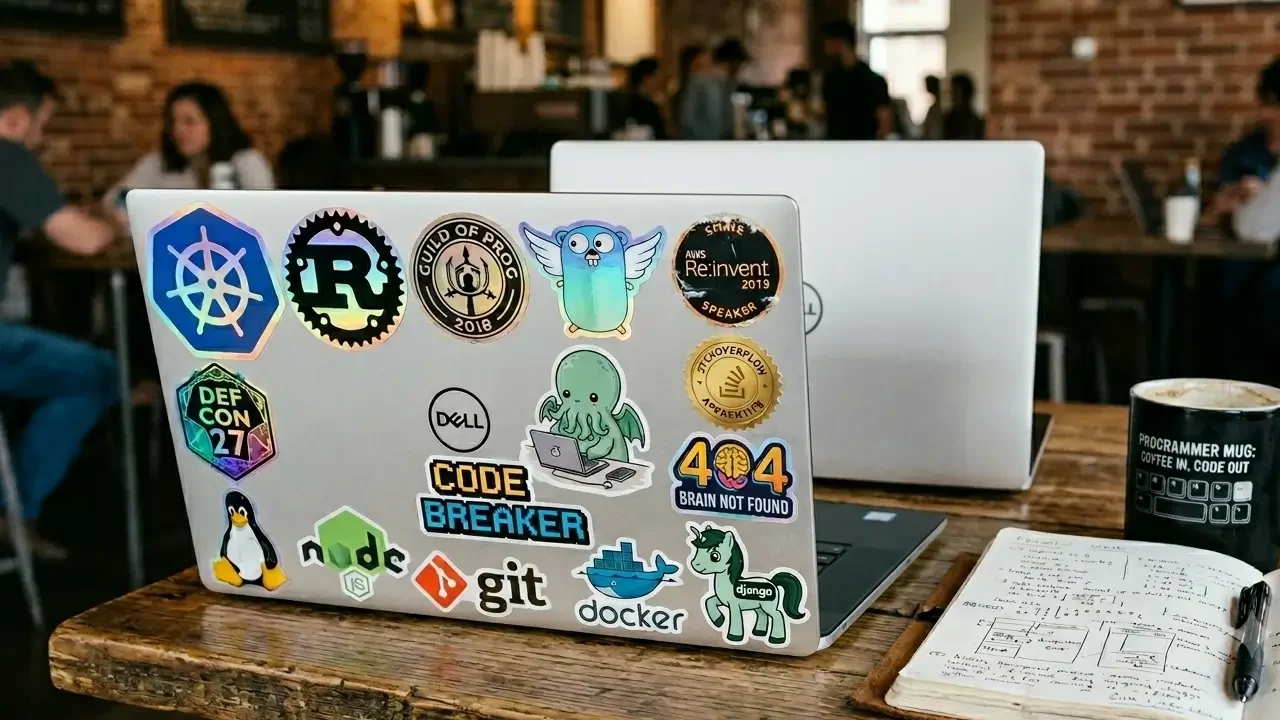
The Long Game Approach
The most impressive developer sticker collections aren’t built in one Amazon order. They accumulate over time through a mix of intentional pursuit, community participation, and being in the right place at the right moment.
Here’s the strategy that produces the best results:
Attend events deliberately for the sticker opportunity – This sounds crass but it’s honest. If you’re choosing between two conferences and one has a history of producing excellent exclusive stickers, that’s a legitimate factor in the decision. The content of the conference matters more, but the sticker opportunity is a real bonus.
Contribute to open-source projects you use – The stickers that come from contribution are the most meaningful in any collection. Pick projects you genuinely use and care about, contribute in ways you’re capable of, and let the swag be a pleasant side effect.
Follow the indie artists before they’re famous – Find one or two independent creators whose developer-themed art genuinely resonates with you and follow their work closely. Being an early supporter of an artist who later becomes widely known in the community gives you pieces that nobody else got when they were easily available.
Trade, don’t hoard – The sticker collecting community has trading culture built into it. Having duplicates of your conference stickers and being willing to trade creates opportunities to acquire pieces you couldn’t get yourself while building community relationships in the process.
Document your collection – A collection with stories behind it is more interesting than a collection without context. Keeping track of where each sticker came from, which conference, which contribution, which artist, turns your laptop lid into a genuine narrative artifact rather than just a decorated surface.
Starting Your Cool Collection Today
If you’re starting from zero and want to build toward something genuinely impressive, begin with a strong quality foundation of developer culture stickers, language logos, authentic humor, community badges, from sources with proven quality.
TechGeeksApparel’s programmer sticker packs give you that quality foundation: authentic developer humor, weatherproof vinyl, designs that resonate with real coding culture. These form the solid base that conference exclusives, indie art pieces, and community contribution stickers can build on.
For the full sourcing landscape, where to find everything from mainstream developer stickers to the rare finds discussed in this post, our guide on where to get the best laptop stickers covers every option across quality tiers and price ranges. And for design ideas to complement your rare pieces, our post on 50+ laptop sticker ideas for programmers gives you the full inspiration spectrum to work with.
Safety First Even With Your Rarest Stickers
One practical note before you apply that exclusive conference sticker you’ve been sitting on: rare stickers deserve extra care during application precisely because they’re irreplaceable.
All the safe application principles from our guide on are stickers safe for laptops apply doubly here. Clean the surface thoroughly. Apply at room temperature. Press from center outward. And if you’re ever considering removing a rare sticker for any reason, to protect it, to transfer it to a new laptop, use maximum patience and heat during removal. A rare conference sticker is worth ten extra minutes of careful removal technique.
If a truly irreplaceable sticker is too precious to risk applying directly, a laptop sleeve or case that lets you display it behind a transparent window is a legitimate protective option worth considering.
Complete Your Cool Developer Setup
A rare and curated sticker collection deserves a setup that matches its energy.
TechGeeksApparel builds the rest of that setup thoughtfully. Their funny programmer t-shirts carry the same authentic developer culture energy as the best stickers in your collection. The developer hoodies are built for the long sessions and the late events where great sticker stories get made. The cozy geek sweatshirts keep you comfortable through the hackathons where you might earn your next rare piece. The programmer mugs fuel the work. The developer desk mats and tech wall posters complete the environment where the stickered laptop lives.
One consistent developer identity. Every element of it considered.
Conclusion – The Coolest Sticker Collection Is the One With Stories
At the end of the day, the coolest developer laptop sticker collections aren’t defined by how much was spent or how many rare pieces were tracked down through strategic effort. They’re defined by story density, how many of those stickers have a genuine moment behind them.
The DEF CON badge from the year you first attended. The Rust Foundation sticker you got when your first PR to the compiler was merged. The indie artist design you found before anyone else had it. The conference exclusive from a regional meetup nobody else in your current team has even heard of. The custom sticker you made for your own open-source project and sent to your contributors.
Those are the stickers that make people lean in. Those are the stickers worth chasing.
Build the collection with intention. Participate in the communities. Show up to the events. Contribute to the projects. Find the artists before they’re famous. And check out TechGeeksApparel’s developer sticker collection for the quality vinyl foundation everything else builds on.
Your laptop lid is a story. Make it one worth reading.
Frequently Asked Questions
Where can I find the rarest and coolest laptop stickers for programmers?
The rarest developer stickers come from tech conferences (DEF CON, PyCon, KubeCon, FOSDEM), open-source contribution programs, and indie artists on Etsy, Ko-fi, and Gumroad. Following developer community forums, subreddits, and Discord servers is the most reliable way to catch limited drops and exclusive releases when they happen. For quality vinyl developer culture stickers as a foundation, TechGeeksApparel’s programmer collection is a strong starting point.
Are limited edition developer stickers worth collecting?
Absolutely, both for cultural value and for the community connections they represent. Limited edition and conference exclusive stickers are conversation starters that communicate genuine community participation in ways generic stickers can’t. The value is social and narrative rather than monetary, but in developer culture those are the currencies that actually matter.
How do I get conference exclusive stickers without attending the conference?
Many conferences offer post-event sticker request forms, virtual swag programs, or community distribution options. Developer communities on Reddit, Discord, and Twitter often organize sticker trades and swaps between attendees and non-attendees. Following official conference social media and community forums is the most reliable way to discover these opportunities.
What makes an indie artist sticker better than a mainstream developer sticker?
Indie artist stickers tend to have more distinctive visual styles, more ambitious creative concepts, and smaller production runs than mainstream options. They often capture niche humor and community references with more accuracy and authenticity because the artists are themselves embedded in developer culture. Finding them requires more effort but produces pieces that genuinely stand out in any collection.
How do I build a cool sticker collection if I’m just starting out?
Start with a quality foundation of authentic developer culture stickers from specialist sources like TechGeeksApparel. Then layer in community participation, attend events, contribute to open-source projects, follow indie artists. Let the rare pieces accumulate naturally as a byproduct of genuine community involvement rather than pure acquisition strategy. For design inspiration and layout planning, our posts on laptop sticker ideas and developer laptop stickers give you the full picture to work with.
![A clean flat lay of nerdy gift ideas under $50, featuring a "World's [0] Programmer" t-shirt, a "I Learned Patience the Hard Way" mug, mechanical keyboard keycaps, and tech-themed books](https://techgeeksapparel.com/wp-content/uploads/2026/06/nerdy-gift-ideas-under-50-programmer-essentials.webp)