Sustainable Programming Career
If you ask a beginner how they feel about coding, they’ll usually describe a state of constant, low-grade panic. Everything is new, the error messages are cryptic, and the sheer volume of “what you don’t know” is overwhelming.
But if you ask a veteran with a long-term programming career, they’ll describe something different: a rhythm.
There is a fundamental truth in tech that no one tells the newbies: Programming is front-loaded with pain. It is one of the few careers that is incredibly difficult to start but becomes significantly easier to sustain as the years go by.
1. The Syntax vs. Logic Hurdle
When you start, you are fighting two battles at once. You are trying to learn the logic of how to solve a problem and the syntax of the language. It’s like trying to write a brilliant novel while also learning the alphabet for the first time.
After a decade, syntax becomes muscle memory. You don’t “think” about how to write a loop; you think about the architecture of the data. This shift is why veteran developers appear to move slower but finish first. The “hard” part of the job the typing is gone, leaving only the creative part.
2. The Power of Pattern Matching
The reason veterans don’t panic when a server goes down is that they’ve seen it before. In the first three years, every bug is a brand-new monster. By year fifteen, you realize there are only about twenty “types” of bugs in the world.
Your brain develops an elite level of pattern matching. You see a specific error message and instinctively know it’s a CORS issue or a database timeout. This “sixth sense” is the secret to longevity in your software engineering journey. You aren’t working harder; your brain is just indexed more efficiently.
3. High Barrier to Entry, High Reward for Mastery
Because it is so hard to start, many people quit within the first 18 months. This high barrier to entry is actually a form of job security for those who stay.
Once you pass the “Threshold of Competence,” you enter a phase where you can provide massive value with relatively little physical effort. This is why senior engineers prioritize readability over cleverness ; they have learned that the most sustainable way to work is to let the computer do the heavy lifting while they provide the direction.
4. Compounding Knowledge
In many fields, your knowledge becomes obsolete. In tech, while frameworks change, the foundational concepts (state management, concurrency, networking, data structures) never do.
The knowledge you gain in year one compounds. By year twenty, you aren’t just a coder; you are a “Systems Thinker.” This compounding effect is why career switchers succeed in tech, they realize that once they get past the initial wall of syntax, their previous life experience makes the “sustainability” part of the career much smoother.
How to Bridge the Gap
If you’re currently in the “hard to start” phase, here is how to reach the “easy to sustain” phase:
- Don’t Memorize, Internalize: Don’t worry about remembering every command. Focus on understanding why a solution works. The “why” is what you’ll use for the next 30 years.
- Build a “Snippet Library”: Don’t reinvent the wheel. Save your solutions. Over time, your library will do 50% of your work for you.
- Manage Your Energy, Not Your Time: Understand that exhaustion in a long-term tech career is usually caused by trying to maintain the “beginner’s panic” forever. Relax into your expertise.
The TechGeeks Directive
Programming is a marathon that starts with a vertical climb. If you can make it past the first few miles, the path levels out into a beautiful, sustainable journey. The goal isn’t to be the fastest climber; it’s to be the one who never stops moving.
Ready to see what the full journey looks like?
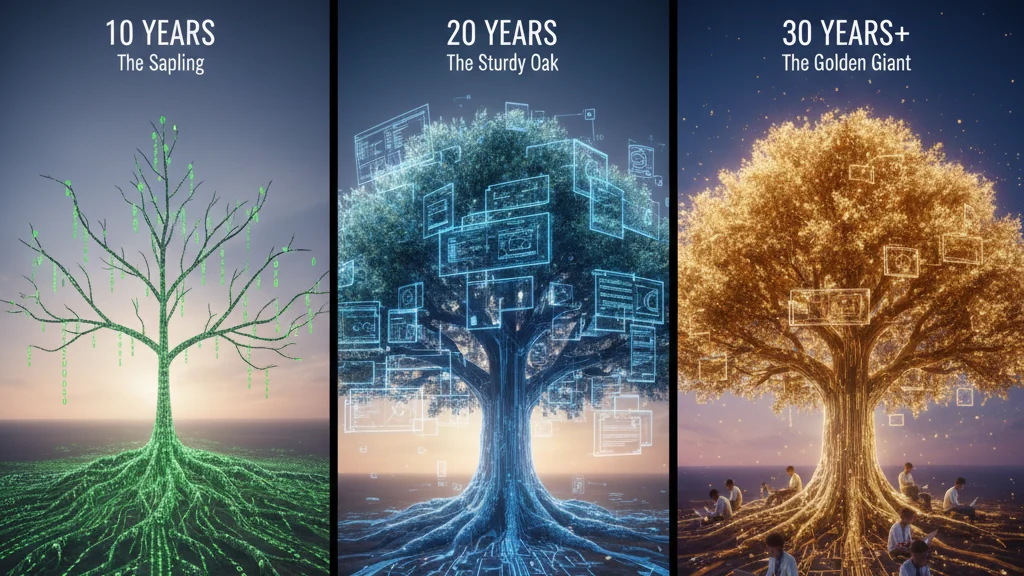
- Dive back into our Post on the 10, 20, and 30-year career milestones.
- Or, if you’re wondering if you should stay in the trenches or move up, explore why some developers leave coding and where they go.
Frequently Asked Questions (FAQ)
Why do career switchers succeed in software development?
Career switchers succeed because they bring domain expertise and soft skills that are often missing in traditional computer science paths. Having worked in industries like finance, healthcare, or education, they understand the real-world context of the software they are building. This allows them to focus on solving business problems rather than just writing complex code.
What are the best transferable skills for moving into tech?
The best transferable skills include communication, project management, and high-pressure problem solving. Career switchers from teaching or nursing often excel at explaining technical concepts to stakeholders and managing cognitive load during system failures. Their ability to speak “Human” as well as “Machine” makes them highly valuable in modern dev teams.
Is it too late to start a programming career at 30 or 40?
No, it is never too late. In fact, starting later can improve software developer longevity because older developers often bring more resilience and a better work-life balance. They are less likely to fall into the hustle culture traps that lead to early-career burnout, focusing instead on steady, sustainable growth.
Do career switchers have an advantage over CS graduates?
While CS graduates may have a deeper grasp of theory, career switchers have an advantage in contextual learning. They map new syntax to real-world problems they’ve already encountered. This practical perspective is why older developers often write simpler code; they prioritize the features that actually provide value to the user over architectural gold-plating.
How can a non-traditional developer find their first job?
The best strategy is to leverage your niche. A former accountant should look for FinTech roles, while a former educator should target EdTech. By combining your previous domain knowledge with new coding skills, you become 10x more valuable than a generalist because you understand the soul of the product you are building.
How do career switchers handle the Experience vs. Speed gap?
Career switchers often instinctively understand that experience beats speed. They bring a level of calm and perspective to server down incidents, knowing that a steady, logical approach is more effective than a panicked quick fix. This resilience helps them navigate the daily programmer struggles without losing their passion for the craft.