25 Surprising Python Fun Facts for Developers
Think you know everything about your favorite programming language? You might be a master of list comprehensions and a wizard with f-strings, but Python has a history as colorful and quirky as a Monty Python sketch. In fact, that’s exactly where it all started.
Whether you’re a seasoned senior dev or a student just starting your 100 days of code, these Python fun facts will give you some serious street cred (and maybe some winning trivia answers) at your next dev meetup. From its secret origins to its world-dominating status in 2026, here are 25 things you probably didn’t know about Python.
The Origin Story: It’s Not About the Snake
- Named After Comedy, Not Reptiles: Guido van Rossum named the language after the BBC show Monty Python’s Flying Circus, not the snake. He wanted a name that was “short, unique, and slightly mysterious.”
- A Christmas Hobby Project: Python was started in December 1989. Guido was looking for a “hobby” project to keep him occupied during the week around Christmas when his office was closed.
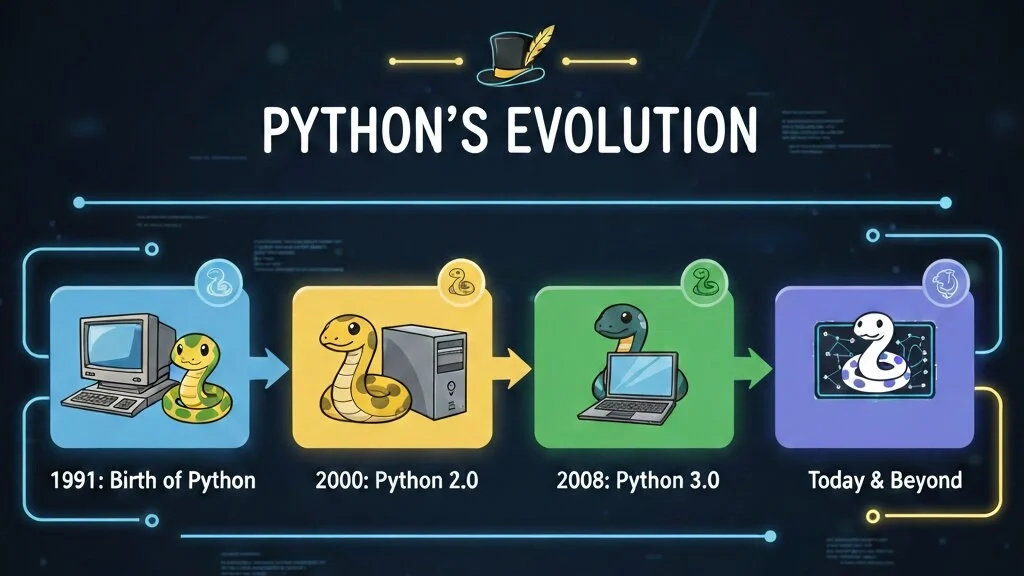
- Python is Older Than Java: Contrary to popular belief, Python (1991) is older than Java (1995).
- The “Bridge” Language: Python was originally designed to be a successor to the ABC language, intended to appeal to Unix/C hackers.
- The First Official Release: Python 0.9.0 was released in February 1991 at the alt.sources newsgroup.
The Secret Features & Easter Eggs
import antigravity: If you type this into a Python script, it opens a web browser to a famous xkcd comic about how easy it is to fly using Python.- The Zen of Python: Typing
import thisin your terminal reveals the 19 guiding principles of Python design, written by Tim Peters. It’s the ultimate Pythonista motto collection. import hello: In older versions of Python, this would simply print “Hello world!”. In newer versions, it’s a fun way to check if your installation is working.- No Braces, Ever: If you try to
from __future__ import braces, Python will throw aSyntaxError: not a chance. We take our indentation seriously! - Fluent in French (Sort of): In 2015, a survey in the UK found that Python was more popular in primary schools than French. 60% of parents preferred their kids to learn coding over a foreign language.
Python’s Global Dominance
- Google Loves Python: Python is one of the four main languages used at Google (alongside C++, Java, and Go). One of their early mottos was “Python where we can, C++ where we must.”
- The King of AI: Over 90% of AI and Machine Learning research is done using Python, thanks to libraries like TensorFlow and PyTorch.
- NASA’s Trusted Script: NASA uses Python for various projects, including the software that manages the International Space Station’s telemetry.
- Powering your Binge: Netflix uses Python for everything from their recommendation engine to their internal security tools.
- The Most Popular Language: As of 2026, Python consistently holds the #1 spot on the TIOBE Index of programming language popularity.
Technical Quirks & Trivia
- Everything is an Object: In Python, even a simple integer like
5is an object. - Multiple Returns: Unlike C or Java, Python functions can return multiple values as a tuple in a single line.
- The Underscore Trick: In the Python REPL (interactive shell), the
_variable automatically stores the result of the last expression executed. - Chain Comparisons: You can write
1 < x < 10in Python, which is much more readable than the1 < x && x < 10required by other languages. - For-Else Loops: Python is one of the few languages where
forandwhileloops can have anelseblock that runs if the loop finishes without hitting abreak.
The Flavors of Python
- CPython: This is the “standard” version written in C.
- Jython: A version that runs on the Java Virtual Machine (JVM).
- IronPython: Designed to integrate with Microsoft’s .NET framework.
- PyPy: A version of Python written in Python that uses Just-In-Time (JIT) compilation to run much faster than the standard CPython.
- MicroPython: A “shrunken” version of Python designed to run on tiny microcontrollers and hardware.
Conclusion
These Python fun facts show that the language is built on a foundation of humor, simplicity, and community. It’s a language that doesn’t take itself too seriously, yet powers the most serious technology on the planet.
Are you proud to be a Pythonista? Show it off with some gear that’s as smart as your code. Check out our Python shirts collection for designs inspired by the history and humor of the language!
Frequently Asked Questions
Is it really true that Python is older than Java?
Yes! Python 0.9.0 came out in 1991, while Java 1.0 wasn’t released until 1995.
Why does Python use indentation instead of curly braces?
To force code readability. The creator believed that code should be easy to read for humans, and consistent spacing makes that much easier than scattered braces.
What is the most “famous” Python joke?
Probably the import antigravity easter egg. It’s the ultimate nod to how Python makes developers feel like they have superpowers.
Can I really use Python for hardware?
Absolutely. Thanks to MicroPython and CircuitPython, you can program everything from LED strips to robots using the same syntax you use for web apps.
How many people use Python today?
Estimates suggest there are over 15 million Python developers worldwide as of 2026, making it one of the largest tech communities on Earth.